Key article highlights
- The Milan metro subscription offers reduced student rates from as little as 18 euros per month.
- Two types of subscriptions exist: monthly and annual, with significant savings.
- The ATM card (Abbonamento) is required to access preferential student rates.
- Those under 26 benefit from a specific "giovani" discount, even without a student card.
- Purchasing online or at an ATM agency is straightforward, but requires a few documents prepared in advance.
- Milan's public transport covers the metro, buses, trams and suburban trains on a single subscription.
- Managing this budget item well is a key step to successfully settling in Milan.
Paying 100 euros or less than 25 euros per month to travel across an entire major European metropolis: that is the reality few students are aware of before arriving in Milan. The ATM network (Azienda Trasporti Milanesi) offers some of the most affordable student fares in Europe, provided you know exactly where to look and how to go about it.
For an Erasmus student, exchange student or intern, transport costs can quickly weigh on a monthly budget. In Milan, a dynamic but expensive city, keeping this expense under control makes a real difference. The Milan metro student subscription is a practical option, little known to newcomers, which provides access to the metro, buses, trams and suburban trains for a fixed and predictable amount.
This guide explains precisely how much each plan costs, who is eligible, how to obtain one step by step, and what tips can help you save even more. Whether you are arriving at Bocconi, Politecnico or any other Milanese institution, this information will help you get your stay off to the right start.
Milan's public transport network: what you need to know before choosing your subscription
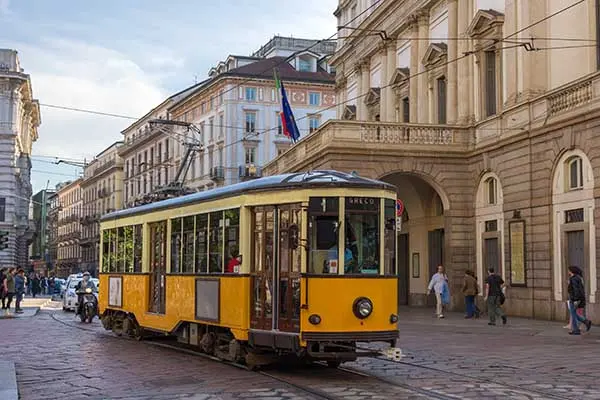
Milan has one of the most comprehensive public transport networks in Italy. The ATM network covers four metro lines (M1 red, M2 green, M3 yellow, M4 blue) with more than 100 stations, dozens of bus and tram lines, suburban S trains serving the outskirts, and night lines running on weekends and public holidays.
The Milan metro network spans more than 100 kilometres of track and carries over 350 million passengers every year. An ATM subscription gives access to all modes of transport included in the chosen zone. For the vast majority of students living in the city, the urban M zone is more than sufficient.
Milan metro subscription rates for students: exact 2026 figures
This is the central question every student asks before arriving. ATM fares for young people are officially divided into two main categories.
The "Giovani" subscription: for those under 26
According to the official ATM youth pricing for 2026, those under 26 benefit from special rates regardless of their student status. The available plans are as follows:
- Monthly urban subscription (M zone): approximately 22 euros per month
- Annual urban subscription (M zone): approximately 198 euros per year, or less than 17 euros per month
- Monthly MI3 zone subscription (outer suburbs): approximately 40 euros per month
- Annual MI3 zone subscription: approximately 360 euros per year
The advantage of the annual subscription is significant: broken down monthly, it works out to approximately 16.50 euros, which is less than ten single tickets.
The university student subscription: for those enrolled at a Milanese institution
Students enrolled at a Milanese university can access rates negotiated between ATM and certain institutions. Politecnico di Milano, for example, offers special agreements with ATM for its students. These rates vary depending on the agreements signed, but are consistently lower than standard public fares. Check directly with your university's student services office as soon as you arrive.
How to get your ATM student card in Milan: the step-by-step process
Obtaining your Milan metro subscription at the student rate takes no more than an hour if you have prepared the right documents.
Required documents
You will need a valid identity document (passport or national identity card), proof of university enrolment, proof of residence in Milan, a recent passport-sized photo and payment by cash or bank card. For EU citizens, no specific visa is required. For non-EU nationals, a valid residence permit may be requested.
Where to apply
According to the practical guide to obtaining a Milan metro card, several options are available: ATM Point offices (Cadorna, Centrale, Garibaldi, Loreto and Duomo), the ATM website (www.atm.it) for certain plans available online, and authorised tabacchi shops for monthly top-ups once the card has been activated. The ATM Point at Stazione Centrale is recommended for its availability of foreign language support. Avoid peak hours (8am–10am and 5pm–7pm) to save time.
Processing time and validity
The physical card is generally issued immediately at the office. The monthly subscription starts on the first of the month, but an application made mid-month can sometimes allow for an immediate start date on a pro-rata basis.
Monthly or annual subscription: which plan suits your stay?
The choice depends primarily on the length of your stay. For a short Erasmus stay of less than 4 months, a monthly subscription is logically more suitable. For a full academic year, the annual subscription becomes significantly more advantageous. The figures speak for themselves: 9 months on a monthly basis amounts to 22 × 9 = 198 euros, which is exactly the price of an annual subscription valid for 12 months. In other words, you travel for free during the 3 summer months, which is particularly worthwhile if you stay in Milan during the holidays or find an internship there.
Consult our complete guide to the monthly student budget in Milan to factor this expense into your overall financial planning.
Other transport options worth knowing about in Milan
A subscription is not always the most suitable solution. According to the official ATM Milan fares, a single ticket costs 2.20 euros and is valid for 90 minutes across the entire urban network. A book of 10 tickets costs 19.50 euros, or 1.95 euros per journey. These options are suitable if you use public transport fewer than 2 to 3 times a day; beyond that, a subscription is consistently more cost-effective.
For sightseeing weekends or the first few days before obtaining your subscription, temporary tickets are convenient: 7.60 euros for 24 hours and 13.80 euros for 48 hours.
Milan and fare zones: don't mix up the zones
This is the most common mistake among newcomers. The ATM network is divided into concentric fare zones that must be identified carefully before subscribing.
The M (urban) zone covers the bulk of the city within the administrative boundaries and is sufficient for 90% of students. Zones MI1 and MI2 gradually extend beyond those administrative limits. Zone MI3, the outer ring, includes towns such as Monza, Sesto San Giovanni and Rho. An M zone subscription will not allow you to take the S train to Monza without paying a supplement: always check which zone covers your route before subscribing.
Factoring transport costs into your student budget in Milan
Transport is an expense often underestimated when planning a stay. With a Milan metro student subscription, this item fortunately remains very manageable. Here is a realistic estimate depending on your situation:
- Student living in the city centre (M zone): 17 to 22 euros per month
- Student in the inner suburbs (MI1–MI2 zones): 25 to 35 euros per month
- Student in the outer suburbs (MI3 zone): 35 to 45 euros per month
These figures contrast sharply with the monthly budget of a student in London, where transport often amounts to 150 to 200 euros per month. Milan remains one of the most affordable European cities when it comes to this expense. To anticipate all your settling-in costs, our checklist for a successful first month in a new country is an essential resource.
Common mistakes to avoid when using public transport in Milan
A few classic pitfalls can cost you dearly. Here are the most frequent ones.
Forgetting to validate your ticket
In Milan, validation is required every time you board, even with a monthly subscription. Inspectors are regularly present and fines can reach 100 euros. Newcomers sometimes learn this the hard way within their first few days.
Confusing the ATM subscription with regional trains
The ATM subscription covers S trains only within the subscribed zones. Trenitalia and Italo trains require separate tickets, even if you hold an annual ATM subscription.
Waiting to subscribe
Some students buy single tickets for several weeks before taking out a subscription. Every week of delay represents a real loss of money. Subscribe during your first week on the ground.
Relying on outdated information
ATM fares are revised every year, usually in January. Figures found on student forums or blogs that have not been updated may be incorrect. Always check directly on the official ATM website or via the official sources referenced in this article.
Transport and accommodation in Milan: an equation not to be overlooked
Your choice of accommodation directly influences your transport expenditure. A cheaper flat on the outskirts may ultimately cost more overall if your zone subscription rises from 22 to 40 euros per month. The same logic applies to commute time: a studio at 800 euros near Bocconi may be a better deal than a room at 550 euros 45 minutes away by metro, once you factor in the additional transport cost and time lost each day.
Before signing a rental agreement, always check the fare zone of the accommodation and calculate the true monthly cost (rent + transport). Consult our guide on finding reliable student accommodation abroad to avoid unpleasant surprises. Platforms such as Spotahome, Uniplaces or HousingAnywhere allow you to filter listings by distance to metro stations, making the trade-off easier. Stay vigilant about fraudulent listings too: our guide on rental scams abroad will give you the right reflexes to adopt.
Additional discounts and benefits to know about for students in Milan
In addition to the preferential rates on the Milan metro student subscription, other schemes can lighten your transport budget.
Grants and support from your university
Some universities include a transport allowance in their welcome grants. Check with your institution's international office before you leave. The Erasmus+ grant also includes an envelope intended to cover part of mobility costs.
Discounts for ISEE recipients
Students from lower-income households may be entitled in Italy to social assistance calculated on the basis of the ISEE (Indicatore della Situazione Economica Equivalente). Some municipalities partially subsidise transport subscriptions within this framework.
Partial reimbursement by an employer or internship host
If you are doing an internship in Milan, your host organisation may sometimes be required — or it may be common practice — to reimburse all or part of the monthly subscription. Negotiate this point when signing your internship agreement. For procedures related to internships in Italy for non-EU nationals, our guide on the internship visa for Italy provides concrete answers.
Preparing for your arrival in Milan: the first steps to take care of
The transport subscription is one of the very first things to sort out, but it is part of a longer list of formalities to complete. Priorities for the first few weeks include registering at the town hall (dichiarazione di residenza) for stays exceeding 3 months, opening a local bank account, obtaining a codice fiscale (essential for almost all administrative procedures), taking out appropriate health insurance and, of course, subscribing to the ATM student pass.
Health insurance deserves particular attention: the European Health Insurance Card covers emergency treatment, but is not sufficient for a long-term stay. Consult our guide on the cover to check for expat student insurance before you leave.
Conclusion: Managing your transport budget in Milan — a reflex to develop from day one
The Milan metro student subscription is one of the best budget optimisations available to newcomers. At less than 22 euros per month for the urban zone, it gives access to a comprehensive, reliable and extensive network covering the metro, buses, trams and suburban trains.
The golden rule remains simple: subscribe during your first week, choose the zone suited to your accommodation, and opt for the annual subscription if your stay exceeds 9 months. Avoiding single tickets on a daily basis allows you to save several hundred euros over the year. Combining this smart choice with a well-located home is the foundation of sound budget management in Milan.
To get your settling-in process started with the right tools, find all our resources on our Milan destination guide, and benefit from SafexPAT's support at every stage of your student relocation.
.webp)
.webp)